Neuroscientist · Neural-Engineering Tool Developer
Postdoctoral researcher at UCLA designing wireless miniature microscopes, open-source neural devices, and scientific software — bridging optics, electronics, and data science to capture neural activity in freely behaving animals.
About
I'm a neuroscientist and tool developer who turns hard measurement problems into devices and software people can actually use. My work sits at the intersection of optics, electronics, microfabrication, and data science — building instruments that record the brain with higher fidelity, lower cost, and fewer constraints on natural behavior.
During my PhD (summa cum laude) at the Leibniz Institute for Neurobiology in Germany, I developed two open-source neural recording devices: a transparent µECoG array for combined electrophysiology and optical imaging, and TetrODrive, a 3D-printed microdrive that costs under $25. Both were published as first-author papers and are used by other labs.
As a postdoc in the Aharoni Lab at UCLA, I co-lead Miniscope Zero — a fully wireless, single-cell-resolution miniature microscope that frees neural imaging from tethers and large batteries. Alongside the hardware I build the data-acquisition and analysis software that goes with it. I also completed a full-time data analytics bootcamp (Python, ML, SQL), reflecting where I want to take these skills next: solving applied problems where rigor, prototyping, and data fluency matter.
I care about making technology accessible and staying involved in the science community. I co-founded SimpleNeuro, a science-communication blog written by young researchers for the public (archived), served as PhD student representative for 50+ graduate students, and review for Nature Methods.
Selected Research
Each project is an end-to-end device — concept, hardware, firmware/software, and validation in vivo. Findings and figures below are drawn from the original publications and manuscripts.
In plain terms: a tiny microscope worn on a mouse's head lets us watch individual brain cells light up while the animal moves freely — and we made it work with no cables or heavy batteries holding it back.
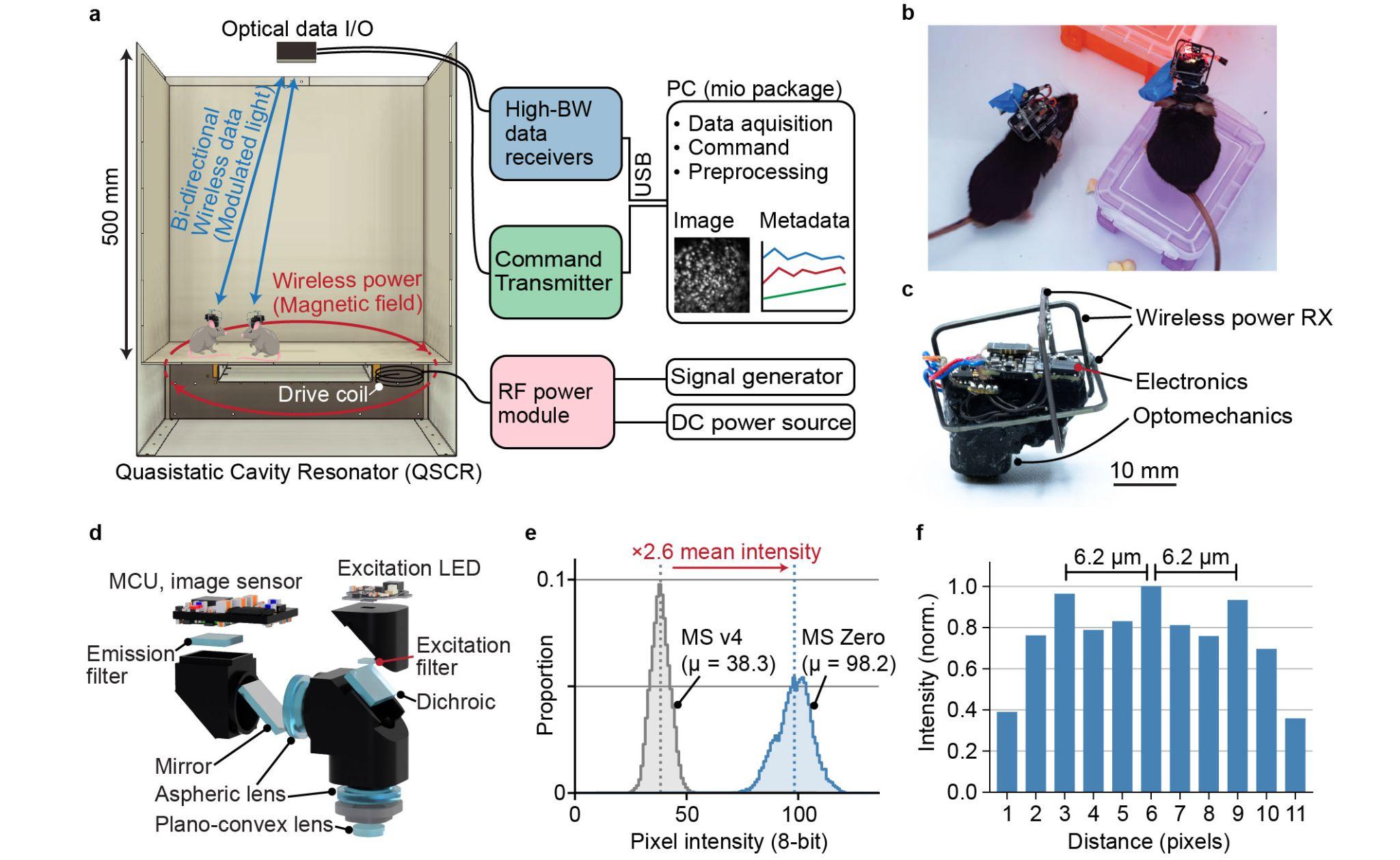
A head-mounted, single-photon miniature microscope that records single-cell neural dynamics in freely behaving mice with no tether and no bulky battery. Power is delivered wirelessly via Quasistatic Cavity Resonance (>500 mW over 2,500 cm²) and data streams over an 8 Mbps optical uplink. Upgraded optics deliver 2.6× the light-collection of the UCLA Miniscope v4, enabling multi-hour CA1 recordings during 3D-maze navigation and multi-animal social interaction.
Co-first-authored with Takuya Sasatani (University of Tokyo). I led the miniature microscope and wireless data link; wireless power was developed in collaboration with Takuya.
In plain terms: a small, 3D-printed gadget that gently lowers hair-thin sensors into the brain to listen to single neurons — built for under $25 instead of the usual several hundred.
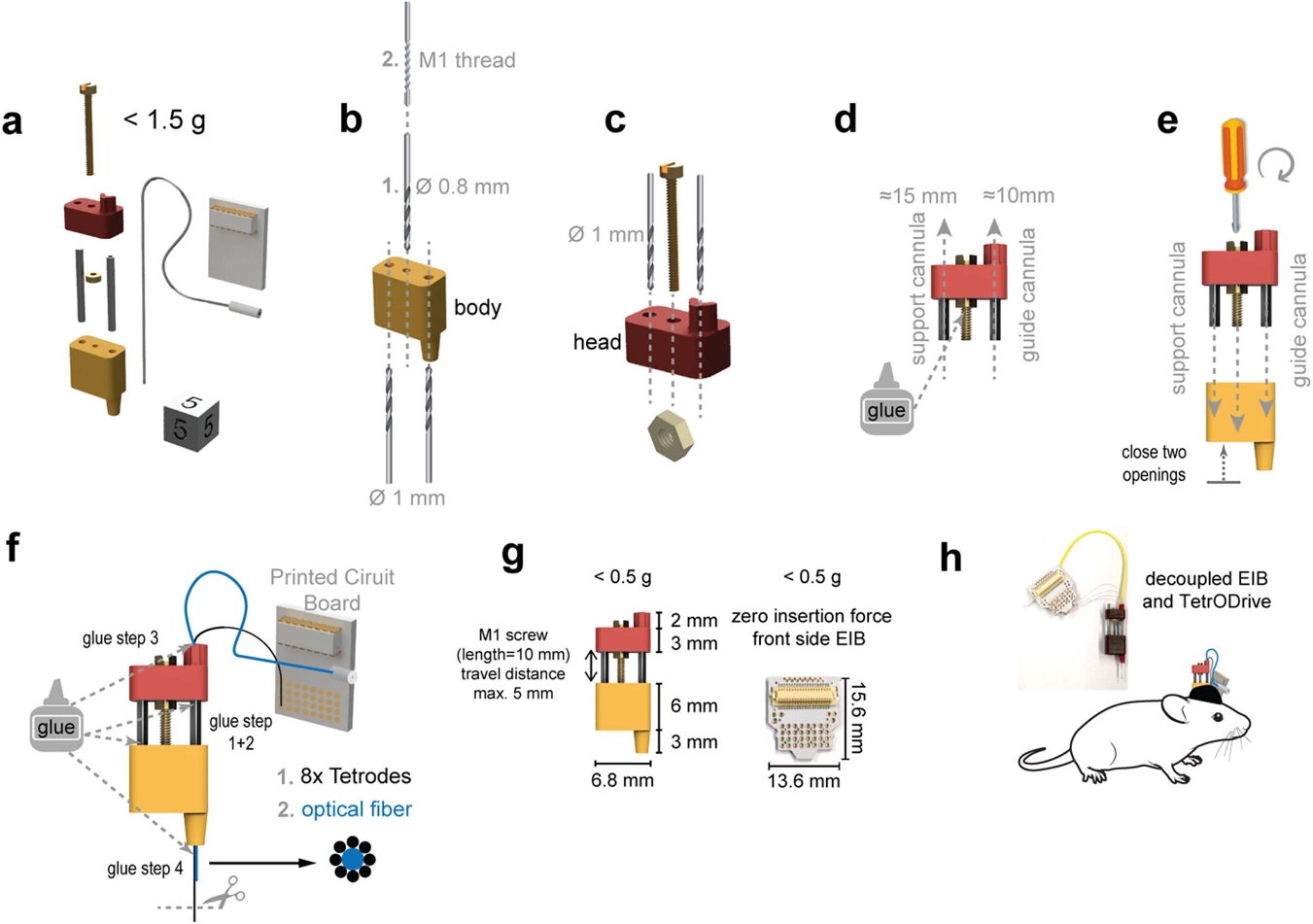
A 3D-printable microdrive for combined electrophysiology and optophysiology in mice. It weighs under 1.5 g, assembles in 15 minutes, and costs under $25 — versus hundreds for commercial units. A key innovation mechanically decouples plugging forces from the drive body for stable recordings across sessions, and a movable fiber enables fiber photometry. We validated it with optogenetically identified single units in the ventral tegmental area.
In plain terms: a see-through electrode film that rests on the brain's surface, so we can record its electrical activity and shine light through it at the same time — thinner than a human hair and stable for months.
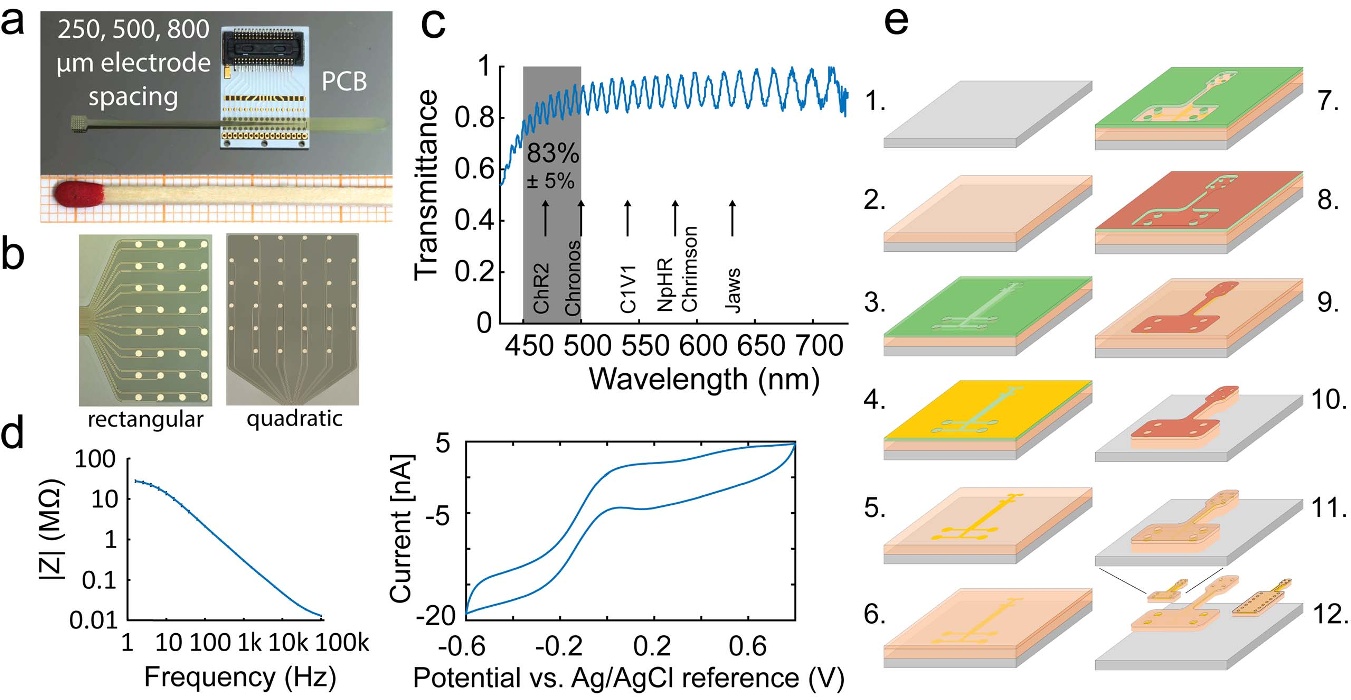
An optically transparent multi-electrode array for simultaneous surface electrophysiology and optogenetics/imaging. Built from ultra-thin polyimide with chrome-gold-platinum traces, the array is just 6.5 µm thick and ~83% transparent to blue light, while rejecting opto-electric artifacts. It records stable ECoG over months without measurable degradation and maps the tonotopic organization of the curved rodent auditory cortex — a robust, low-cost alternative to fragile graphene/ITO devices.
Software & Open Source
Beyond hardware, I build and contribute to the software stack around neural imaging — from data acquisition to analysis GUIs — much of it open source and used across the Miniscope community.
An interactive calcium-imaging deconvolution GUI that lets researchers tune and visualize spike-inference parameters on their own recordings — built in collaboration with the Aharoni Lab.
Launch CaTune ↗Next-generation data-acquisition software for Miniscope devices. I help develop the acquisition and streaming pipeline that handles incoming neural data and outgoing device commands.
View on GitHub ↗An open-source MATLAB tool for combined analysis of head-mounted calcium imaging and behavior, published in Frontiers in Neuroscience (2018).
Read the paper ↗Capabilities
A rare combination of scientific rigor and hands-on building — from data pipelines and software to physical prototypes that ship and get used. Hover any skill to see the projects behind it.
Experience & Education
Developing tools that address current challenges in neuroscience and medicine, with a focus on one-photon imaging with wireless miniature microscopes (Miniscope Zero) and the open-source software around them.
Python data analytics, MySQL, building/evaluating/deploying ML models (scikit-learn), inferential statistics, APIs, web scraping, and data visualization.
Developed neuroscience tools combining electrophysiology and optophysiology: a transparent µECoG array and the TetrODrive optrode microdrive. Awarded the Faculty of Biology’s Promotionspreis for the best doctoral dissertation of the year. Advisors: Prof. F. Ohl, Dr. M. Lippert.
Thesis on functional auditory cortico-striatal coupling during two-way active avoidance learning, combining ECoG, local field potentials, and behavioral analysis.
Thesis optimizing the Barnes maze protocol to reliably detect differences in spatial learning between cyclin D2 knockout and wild-type mice — quantifying how protocol parameters (e.g., inter-trial intervals) affect measurable memory performance.
Publications
Selected journal articles and conference papers. First-author work in bold.
Plus the Miniscope Zero wireless-imaging manuscript in preparation (co-first author, UCLA). Invited talks include the German Neuroscience Meeting (2019) and the German Physiology Society (2016); Best Talk Award, Young Physiologists Symposium (2015).
Contact
Open to roles in neurotech and biotech — spanning R&D, instrumentation and hardware, and data science. I'm always glad to talk and happy to share my code or device designs.